Sunday, December 16, 2007

Artist Lecture # 6: Justine Kurland


Alright everyone, I promise to make this one short and sweet. Thank you all for humoring me and putting up with my online tirades throughout this semester. Senior Portfolio has been a strange but beneficial experience, kind of like speaking with Justine Kurland. Although I had seen Kurland’s work previous to her lecture at VCU, I didn’t fully understand it. Some of her work with the girl runaway’s was shown in a contemporary photo class and I remember being intrigued by the images but not blown away. Seeing the scope of her collective bodies of work was really impressive. Hearing her speak about the relationship that her images have to classic American landscape photography was also interesting. One of my favorite things about photography is hearing other people’s interpretation about a photograph. I loved when she showed a picture of these strange looking men cutting down the redwoods and said they looked like elves coming out of these primordial woods and the holes in the trees looked like big vaginas that were swallowing them. I feel like, I see those things too because once I hear it I’m like wow, yeah those really do look like giant vagina’s, but I think that in my mind those connections remain kind of subconscious. I mean I could never actually make all of those connections and verbalize them the way Justine Kurland does, but once someone points it out I feel like oh yeah, that’s why this picture makes me feel that way. I think that you must need a very good understanding of art history to think this way. Sometimes I feel that having a degree in art history or psychology or literature would help me so much as an artist and then other times I wish I could just be like Henry Darger. Anyway, sitting with Justine Kurland and showing her my prints was nerve-wracking and exciting because she has all of this knowledge in her brain and brings it all into you’re work when she’s looking at it. It reminded me of when I used to see a psychiatrist, you want to hear what that person sees in you but at the same time you don’t want to hear it because you’ll probably be told to stop doing something that you like to do. I was really happy that she chose my favorites as her favorites too. Then she told me why the others didn’t work the same way. Mostly in these the issue was they were too staged and not enough was left up to chance. I find that all of my favorite images usually have caught some moment that can never be recreated. Like with Justine’s work, my favorite picture she showed was the naked girl in boots with a rooster/chicken thing on her shoulder and it lifted its wing at just the right moment and in the photo it looks like she’s morphing into this crazy bird creature. From now on I’m just not going to take photos anymore unless there is some element that is left up to fate. Another thing she pointed out was that in some of my photographs the light comes in and becomes its own entity in a way and in others it does not. I love that Kurland uses no artificial light in her work and that the quality is still so amazing because I only use natural light so this advice was very welcome. She told me that I have a strong sense of formal composition which no one has ever told me before, and also said that it is difficult to shoot landscapes in a square so she suggested that I use a rectangular format. She explained that this is more how our eyes see. Makes sense to me. She also called me a romantic and ghost hunter, and we talked about William Faulkner. Then I disclosed that I was shooting with a pinhole and she told me to get a real camera. Oh well, you win some you lose some. So, overall my experience of meeting with Justine Kurland was like going to the therapist. She gave me a lot to think about and it’s something that I should probably do more often.

Saturday, November 24, 2007

Artist Research: Joel Sternfeld


Joel Sternfeld earned a BA from Dartmouth College and is currently a professor of photography at Sarah Lawrence College in New York. Sternfeld began documenting the relationship between humans and the land they inhabit with his first book, “American Prospects”, in 1987. Someone recently suggested that if I had never seen his work I should look it up. The artists name didn’t sound familiar however as soon as I found a website with his work I recognized one photograph immediately. The photograph is of a roadside vegetable stand where someone is selling pumpkins in the rural countryside of McLean, Virginia. The encompassing fall landscape and banal little stand would seem to be picturesque except for a house that is becoming completely engulfed in flames less than fifty feet away. I was also familiar with some images from his abandoned railway series in New York however, I had not ever heard of “On This Site: Landscapes in Memoriam”, published in 1997. In this book Sterfeld examines the land where recent violent crimes had been committed in America. The first example I could find of this series is a photograph of a small mint green house, the windows and doors are boarded up, and there is not a trace of recent human interaction within this environment. With much of Sternfeld’s work, including this image, he employs a certain deadpan approach to the camera. The title of this photograph is the name of the street and the date on which the picture was taken. The accompanying text to these images states simply, “From the 1920’s to the 1950’s, the city of Niagara Falls, the United States Army, and the Hooker Chemical Corporation dumped over 200 different toxic chemicals into Love Canal”. The straightforward narration of the photograph through its title, mimic the image in that it is both informative and uncomplicated. In another picture we see the front yard of a rundown apartment building in St. Louis Missouri, where nine year old Christopher Harris was grabbed from the steps in front of his home, and used as a human shield in a drug related gun shooting. The boy was shot and fatally wounded in this nondescript yard. On September 3, 1991 a fire swept through the Imperial Food Products chicken processing plant in Hamlet North Carolina during work hours. 56 were injured and 25 employees died because of illegally locked exits. Survivors from that day later stated that the doors were kept locked by management to keep employees from stealing chickens. Sternfeld’s photograph of this site focuses on one of these doors from the outside. It is painful to imagine that at the time of the fire people probably rushed to this door in a panic only to realize that they could not exit there. There is something awful in the mundane-ness of each of these sites. More than anything these pictures capture the horrible truth of how uninvolved and apathetic we’ve become as Americans to the stories that make up our landscape.

Saturday, November 17, 2007

Submissions:VMFA & American Photo on Campus


VCU Lecture # 5: Sister Spit


Sister Spit is an all female, spoken word and performance art, traveling road-show. The show has been touring since 94’ and has featured many published writers. Although the cast changes from year to year, past performers will sometimes make a guest appearance as the tour travels the country. The overall collective of the 2007 tour includes but is not limited to lesbians, poets, feminists, visual artists, sex worker activists and novelists. There are seven artists on tour currently and each of them read a piece when they came to VCU last week. I was surprisingly entertained by Chelsea Starr who decided to read an old blog entry. I was impressed at how captivating someone could be with a computer in front of their face reading words from a screen. I feel that somewhere traditional spoken word artists and poets must be balking at the thought of this happening, like maybe it’s bastardizing the art form, but there was something intimate about the situation that was appealing, kind of like someone reading to you from their private journal. The second blog she read was about her experience of falling in love with an older nun while staying at a convent during a nervous breakdown she was having. It reminded me that I still really want to see those two nuns making out in Su Freidrich’s film. I enjoyed each artist’s work, especially Michelle Tea whose allegorical piece about pigeons almost made me cry. In the poem she challenges that a pigeon is really a dove, made filthy by the city that we’ve built up around it. Then we turn around and condemn the pigeon and hate it for learning to survive in the hostile environment that we’ve created. I’m pretty sure it’s all about prostitutes but it still works on that other level for pigeons. I mean, I have nothing against prostitutes but I really love pigeons, and possums. I have a soft spot in my heart for anything that ends up road kill in the city. Next Michelle recited a poem about her unhealthy relationship and eventual breakup with America. As I looked around the room I could tell that the rest of the students there seemed to be really responding to what the performers were saying. You could tell that about half in not more of these kids were gay (the show was put on through VOX and queer action from what I understand), and there were these two really young looking girls there. I felt really sad for a minute and wondered, if they grew up in Richmond and if it's hard for them to be gay here. I mean compared to being in DC or New York, I know it's not the same. In DC it seemed, to me anyway, like gays owned the city. It's strange how tolerance and culture can change so drastically in just less than two hours in this part of the country. I have spent time in Baltimore, Richmond and DC and I just can't get over the difference. I do think that Richmond is trying very hard to be progressive and it helps, especially those younger people, when groups like Sister Spit come speak, to give a perspective from other parts of the country.

Thursday, November 15, 2007

VCU Lecture # 4: Midge Potts


Midge Potts, a Persian Gulf War veteran from Springfield, Missouri came to VCU last week to talk about activism, civil disobedience and transcending the conventions of traditional politics. Ms. Potts has been arrested on the steps of Capitol Hill several times for engaging in peaceful (maybe somewhat disruptive?) protest, that often involves a per formative element. The result is like political protest street theatre. Potts and Code Pink (Women for Peace), are becoming known for their appearances at on the floor of Congress, at hearings and anywhere else they can be seen waving a banner of protest. Their antics may seem silly at times, like Midge standing on tiptoes in a bright pink shirt which read "Impeach Bush Now" behind Valerie Plame giving testimony before a House panel. However these actions landed Midge an interview on CNN the following evening. At the lecture she spoke about how the press which for most of us seems so inaccessible has given her a voice and how the media and government are supposed to be here for the people. In 2005 Midge was arrested for enacting a performance protesting the tortures at Abu Gharib and Guantanamo Bay. She and two other anti-war activists were wearing outfits similar to those prisoners in the camps and were assuming the positions of prisoners. On her MySpace profile all of these videos are available but when I played this one I couldn't tell why they were being handcuffed and arrested. They weren't even really being loud, I'm guessing that maybe there are certain parts of Capital Hill where any protest if illegal. In 2006 she ran against House Minority Whip, Roy Blunt as a republican in the Missouri primaries. Although she lost Midge did receive over 4,000 votes and became the first transgender individual to ever run in the Missouri primary elections.

VCU Lecture # 3: Su Friedrich


I just finished reading the script of "The Tie That Binds" on Su Friedrich's website. I was intrigued by the short clip that she showed of this film during her lecture at VCU a few weeks ago. The film, made in 1984, is set up in the form of an interview that the artist is giving to her mother. The narration of her questions is done silently through text that appears on the screen, her mother however is actually heard speaking. I believe Friedrich said that part of why she made the film was to try and understand why her mother made the choices that she did in her life. This woman, Lore Burcher, was born in 1920 in Ulm, Germany and came to live under the Nazi regime. She and her family were very much against the regime and although it was dangerous for citizens to voice opposition her family did all that they could do without being killed. She talks about a group of people who, in 1943, were found and executed for distributing anti-Nazi propaganda. Before reading this account of what her family went through I never really thought about the German people who opposed Hitler's army and what their lives were like. I knew of course that not all German's were Nazi's, that many of them despised Hitler and fled to different countries. I just assumed that people either fled or they were killed, oddly enough I never really thought of the women who couldn't run because they had to take care of their children. I'm sure they did whatever they had to do to keep their children safe but it must have been like living in a prison. Then the woman talks about how after the war she felt that she would always be hated by the world just for being German, so not only was her life destroyed but then she came to be affiliated with the people who destroyed it. Although I haven't seen the film the whole way through I think that Friedrich's method of telling her mother's story is really effective. This woman's life and the way she speaks about the war and what she's lost is heartbreaking and it's a unique story that is not often heard in America.

Sunday, November 4, 2007

Artist Research: Selden Richardson


Author Selden Richardson is a native of Richmond and serves as the President of the Board of A.C.O.R.N., the Alliance to Conserve Old Richmond Neighborhoods. He received a Master's degree in Architectural History from VCU, and has an undergraduate degree in history. Mr. Richardson's book "Built by Blacks", which was published in 2006 and is currently in it's second edition, is a comprehensive history of Richmond's black neighborhoods and architecture. The book begins with the origins of the slave trade in the Shockoe Bottom District, and gives detailed accounts of what the jail's, auction houses and slave quarters looked like in the city. The book also reveals the hardships that black communities and churches struggled through during the Jim Crow Era of the 20's and 30's, up through the Civil Rights Movement of the 1970's. Many of the stories in this book seem unbelievable, particularly the story of a community that almost didn't survive, called "Westwood". Westwood is a small neighborhood in Richmond's West End. It's origins date back to the late 1800's when a community of former slaves who lived in the West End, inherited land after emancipation through it's transference to the Westwood Colored Baptist Church. This small and close-knit community, which was completely surrounded by white residents, became isolated and self-sufficient with it's own store, church and school. Westwood's small, two room schoolhouse, served the community for several years before it was closed in 1948. Black students then had to be bussed twenty minutes away to the Carver School even though the nearby Westhampton School for white children could literally be seen from Westwood homes. In the years that were to follow one attack after another was made upon the community in an effort to force them to vacate by the surrounding white residents. After it's annexation into the city the withholding of essential public services such as water and sewage began. Many of the wells that served Westwood citizens were condemned and in 1945 two hundred of it's citizens were forced to walk to a pump at the corner of (today) Willow Lawn Dr. and Patterson Avenue for all of their drinking water. Wait a minute, let's go over that one more time because every time I read this story it becomes more difficult for me to believe. So, 62 years ago in 1945, in our community two hundred tax paying law abiding families were denied the right to water and sewage in their homes and had to walk to a pump if they wanted a glass of water. What? I'm sure that someone at my school has grandparents who remember when this happened however, had I not read this book I never would have known about it. At the same time that this was going on taxes were increased so the community was paying more money to live in houses where basic public services had been denied. When the Health Director requested that sanitary living conditions be extended to Westwood, the Board of Aldermen members expressed their fear that providing city water and sewage would "be followed by enlargement of the Negro settlement". Conditions remained the same for 53 out of 65 homes until April of 1947. During these same years however, Westwood citizens faced another danger when several West End community associations supported a proposal to demolish the homes for the purpose of creating a community park. The residents in favor of the proposal stated that not only was there much need for a park in the area, but that it "would result in the greatest good for the greatest number". Once again, I have to remove myself from what I know of Richmond in 2007 and try to imagine the West End in 1945. There was no Target, no Barnes and Noble or Ritz Camera. What is currently littered with strip malls and fast food places was a couple of houses and big open plots of land. There were plenty of locations where a public park could been established without having to bulldoze and entire community. Citizens who opposed the park proposal stated that Westwood citizens would have nowhere to go if their houses were destroyed. To this the Civic Associations attorney L. Gleason Gianniny replied "There are hundreds of places for them to go". His suggestion was the areas south of Cary and east of Meadow St.

Monday, October 29, 2007

Artist Research: Chester Higgins Jr.


Chester Higgins Jr., attended a historically black university where he studied under P.H. Polk, (Photographer at the Tuskegee Institute and the official photographer of Booker T. Washington). Higgins went on to become a staff photographer for the New York Times. He has been with the publication since 1975. His books include "Black Women, Drums of Life, Some Time and Feeling the Spirit:Searching the World for the People of Africa. He has shown many solo exhibitions in museums and galleries in cities across the country including Richmond. I had the opportunity of seeing Chester Higgins' work in 2006 at the Black History Museum in Jackson Ward. The tittle of this show was "Invoking the Spirit: Worship Traditions in the African World". Higgins has photographed many people and their religious traditions in countries across the African continent and the world.
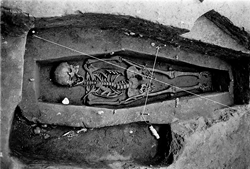
In 2003 his work appeared in an issue of the publication "Archaeology" after the photographer documented the remains of the hundreds of bodies which were uncovered from a parking lot two blocks north of New York's City Hall. This discovery made in 1993 challenged the popular belief that there had been no slavery in colonial New York. It also created controversy between the local black community and city developers who were planning to build over the "Old Negro Burying Ground". A team of anthropologists were brought in from Howard University to make certain that the ancestral remains would be handled with care and respect after a number of protesters laid down in front of bulldozers. "The African Burial Ground, as it is known today, became a "microcosm of the issues of racism and economic exploitation confronting New York City," says Michael L. Blakey, a Howard University anthropologist and the burial ground's scientific director. The research revealed many things about the lives of that these people led. Remains of many individuals exhibit bones that had been broken during life, severe physical strain and disease. One woman was found to have a musket ball lodged in her ribcage. many of these bodies were placed into the ground by their loved ones facing home, towards Africa. Twelve years after these bodies were exhumed, in 2003, they arrived back in N.Y. City and were taken in procession up Broadway to their final resting place, the African Burial Ground. Under the authority of the Antiquities Act of 1906, President George W. Bush proclaimed a 15,000 square foot portion of this site a National Monument on February 27, 2006. It is estimated that anywhere between 10,000 to 20,000 bodies are interned there. These estimates are considerably less than the number of bodies that currently lie beneath the interstate, North of the Lumpkin's Jail Site in Richmond's Shockoe Bottom. The NPS Archeology Program website refers to the monument in Manhattan as the oldest known urban African cemetery, but we can never be sure if this theory is true as Richmond's oldest cemetery remains inaccessible.

Thursday, October 18, 2007

VCU Lecture # 2: Kate Gilmore


Where is this magical school in Maine that both Kate Gilmore and William Pope.L have in common? I just want to go sit on the campus for a day and see what the hell everyone is doing there! Although I don’t think I will ever become a performance artist, this semester has influenced my way of thinking about the importance of performance art. I have a great deal of respect for anyone who can stand in front of the world and put themselves on display for the sake of their art. I love performing for my camera, when no one else is around, but as soon as other people are there I can’t concentrate and the meaning is lost. These artists however seem to thrive on the idea of an audience’s immediate response. Kate’s work has a strong entertainment element and the videos she showed were also formally and conceptually engaging. Her physical struggles in these performances often deal with the idea of the “perfect” character falling apart. Through this deterioration of character Kate is able to break conventional female roles. The characters in the beginning may seem inconsequential but as their struggle progresses so does our ability to empathize with them. Her performances also ask, what is it that motivates us to keep up the daily struggle in our lives? This concept was illustrated best in “anything”, where the artist constructs an impossible ladder out of chairs, string and a table in order to reach the camera overhead. Her willingness and determination to achieve her goal even in the face of danger is both comical and endearing. The one video that was hard for me to watch was when Kate was pushing her head through a star shaped hole in a piece of particle board. Although “Cake Walk” was probably more painful, overall I think there is something scary about a person hurting their face. While many of Kate Gilmore’s performances may seem lighthearted on the surface, one can still see a connection through certain elements to the more serious performance artists of the 1960’s and 70’s. Maria Abramovic’s work tends to be darker with little humor involved, however the two artists both base their performances on the element of danger and an action/ reaction situation where there is no way to be certain of the outcome. In my own work I often seek out places with an element of danger to perform. The risks of “being caught”, combined with the voyeuristic aspect of experiencing another person’s private life, are the dangers that work as a catalyst in the process of my art. The stranger or more unexplainable the circumstances of a place are, the greater is my desire to explore there.

Sunday, October 14, 2007

VCU Lecture # 1: Gail Dines


Gail Dines is a Professor of Sociology at Wheelock College in Boston. She received her Ph.D. from Salford University in England and is co-author of Pornography: The Production and Consumption of Inequality. Dines began her lecture at VCU last Thursday with a brief history on the relationship between pornography and capitalism in the United States. In 1953 the first edition of playboy magazine was published and became an instant success. What Hugh Hefner realized was that for the magazine to make money he would have to make advertising look sexy, thereby sexualizing commodity. Not only did he make it work, but fifty years later the mainstream media is still saturated with "sex sells" images. Dines then spoke about what it was like to grow up in a text based culture, vs. an image based culture. When porno magazines like Playboy first came out it would have been very difficult for young boys to acquire them, and most likely they would have to raid their parents stash in order to see them. Today, recent studies show that boys as young as 10 and 11 years old are likely to experience pornography for the first time on the Internet, and this type of porn is extremely graphic, body punishing and humiliating to women. The most common type of porn that is being marketed on the Internet today is not about sex, it's about violent and humiliating acts that strip women of their sexual autonomy. Not only are these images dangerous to (obviously) women everywhere, they are detrimental to young, impressionable boys who can access these sites. What kind of message do these images send to young men about women? That all women deep down are whores who like to be abused? Or maybe there's just a certain "type" of girl who it's okay to treat this way. The ideology of porn is so dangerous. It reinforces the "Madonna/Whore" stereotype so strongly that even women start to believe it, and then we are divided, we are judging each other and that's exactly what they want. If we're too busy arguing then we can't try to stop them from making money (not that we could really stop a 57 billion dollar industry if we tried). The massive inferiority complex that the pop culture/media industry has ingrained in us helps them to turn around and then sell us more makeup, more fashion magazines and more porn. Think about how much the mainstream media loves to hate Brittney, Paris and Lindsey when they sold them to us in the first place. What I will never understand is how intelligent women get caught up in trash culture talk. I've heard women pass judgement so harshly on each other and it breaks my heart. It is my belief that as a feminist it is counterproductive to call other girls whores, sluts or bitches. It is also important to remain compassionate towards sex workers because while they are working against what I believe in, they are still people with unfortunate circumstances, and if I condemn them then I'm no better than the men who are exploiting them. Yes, they make it harder for me to be seen as an equal and this infuriates me, but I also realize that they didn't create the market, and if there wasn't a market for it they wouldn't be selling it. Most women who end up in the porn industry are there because of drug addictions. Contracts from the companies almost always offer rehab as an incentive to have sex for money. Many girls also come from a childhood where they experienced sexual abuse and probably never felt any autonomy over their own body in the first place. The porn industry for most women is not really work; the relationship between these girls and their companies is closer to a master/ slave relationship than any other line of work in this country. Another point Dines made that I have always felt is true; radical feminists care about men a lot more than the companies who are making money off them. Feminists are opposed to the harmful ramifications of gender constructs for both women and men. For men to feel like they will be more desirable to women because of the car they drive or the amount of money they can throw around is a real pressure placed on them by a capitalistic society that wants to make them feel inferior, in order to then sell them what they are "lacking". It's interesting that feminists often are labeled man haters when in reality they are usually deeply compassionate people who have husbands and sons. If we are to believe that feminists truly hate men then what can be said of the men who are running the porn industry? Are they men lovers?

Wednesday, October 10, 2007

Artist Research: Clarissa Sligh


Clarissa Sligh teaches in the Graduate Photography Department at the School of Visual Arts in New York. Her artwork is based on family experiences and community stories. Through archival images and old photographs Sligh confronts issues of racism and sexism in a historically American context. In 1989 Sligh created one socially conscious piece as a site specific installation for a show at the Air Gallery in New York. This retrospective was titled “Mississippi in America: We Knew They Might be Killed”, and served as a commemorative for the murders of Michael Schwerner, James Chaney and Andrew Goodman. The exhibit marked the 25th anniversary of their deaths. The three boys were civil rights workers, all in their early twenties, who were working to register black voters in Meridian, Mississippi. When the Klu Klux Klan discovered this they made a premeditated plan to kill them all. All three boys were together one day in the June of 1964 when they were stopped and brought into the county courthouse on an alleged traffic violation. They were released later that day but on the way back to Meridian were stopped again on a remote road in the countryside. One by one the boys were executed and their bodies hidden. The investigation into this crime ended up being a catalyst for Civil Rights activists all over the country and drew national attention to the state of Mississippi. “It was an old-fashioned lynching, carried out with the help of county officials, a form of activity that had been going on since 1865, but the Federal Government had refused to intervene. Now "the nation" was shocked. Many historians say the government was finally mobilized to investigate the case primarily because two of the victims, Goodman and Schwerner were white.” Clarissa Sligh’s installation honors the memory of these three people who died fighting for the Civil Rights of others. There are many contemporary artists who are using the idea of the “memorial” in their work today. It serves as a vessel for expressing different emotions and political ideas. My work on the slave trade in Richmond helps me to communicate with people in my community about my frustration for the lack of awareness and disregard for African American history here. In the beginning stages of my research I encountered many people who didn’t know that Richmond played an enormous role in the slave trade. So much has been left unpreserved that it’s hard to tell where to place the blame when civil war hospitals have been turned into nightclubs and burial grounds lie underneath the interstate. An auction house still stands in the middle of downtown and there is no information about humans being sold from inside this place, not a single marker. I remember watching the movie Mississippi Burning with my parents when I was little. They didn’t shelter me from history at all so it was common for me to watch movies like this with my parents. I particularly remember watching one movie with my mother about the Lakota Indian massacre. When I cried my mother comforted me by saying “it’s okay to cry for all those people because if we don’t remember them then it’s like they lived for nothing”. I guess that memorials are just a way to reaffirm that belief, that people actually live for a reason.

Artist Research: Radcliffe Bailey


Radcliffe Bailey, a contemporary multi-media artist and Professor of Painting at the University of Georgia, uses personalized found objects as well as family photographs to create work that explores issues of race, heritage and memory. He draws inspiration from both African and African-American cultures and will often include images of ritual objects and the lyrics of slave spirituals in his art. Bailey's paintings and installations often refer to ideas of migration (both physical and spiritual), and they also reference family. In one series Bailey uses the vintage photographs of his ancestors and collages around the pictures dried flowers, sheet music and other artifacts. On working with personal family heirlooms Bailey says, "Growing up I spent a lot of time with my grandparents and great-grandparents and I feel like that's lost in most family's today. In my art, I try to restore some of the lost kinship between people". In a 2005 exhibit at the Jack Shainman Gallery in N.Y., Bailey showed a series of work that explores the experience of the Middle Passage Journey. The collages incorporate images of African symbols, model ships that have been painted black, drawings of ships and water, piano keys, flags and archival images of people in bondage. In the piece "Door of No Return, 2007" the artist has taken a photograph of the ocean and covers this with a sheet of black paper coated in glitter, which refrences the universe. He then cut out of this top layer a hole so the viewer can only see a square of ocean as if to say, "look, this is how an entire history is constructed." In one of Bailey's most recent works, which is a site-specific installation, an antique model ship lays on it's side and would appear to be wrecked among the debris of wooden planks. Although only one ship is visible the hundreds of wooden planks that lay scattered in a pile bring to mind the hundreds of ships that it actually took to make slavery possible and the countless number of lives that were claimed by this holocaust.

Artist Research: Michael Ray Charles


Michael Ray Charles is a Professor of Art in the Department of Art and Art History at the University of Texas, in Austin. His paintings investigate the legacy of racial stereotypes that have permeated the American subconscious since the days slavery. Drawing from the history of American advertising Charles uses iconic symbols from product packaging, billboards and commercials from both the present and the past to pose questions about the perceptions of black identity in America. Often the artist paintings reference figures from black memorabilia such as Jemima's, minstrel performer's and mammy's. "They're images that are constructed, they're both black and white, conceived in a white mind and believed in a black mind" says Charles. The very word memorabilia in my mind is problematic in the sense that it begs the question "who's memory?" In whose image were these cultural artifacts created? And what would our history be like if for two hundred years the tables were turned and blacks were in control of producing all the images we see of whites. Collectible items such as coin banks, salt and pepper shakers and syrup bottles adorned with images of black servants and performers were produced well into the early 1900's. After emancipation and during the Jim Crow era it was just one more way for white Americans to instill systematic racism. During these times there were parts of America where very few whites had ever seen a black person. Memorabilia and product packaging that functioned this way had an negative effect on how white America perceived African Americans at this time. In certain works like "(Forever Free) Now Playing" and "(Forever Free) #9", the figures are dressed up like jesters and clowns. They juggle and dance, grinning eternally as they perform the role that is expected from them by a white audience. Michael Ray Charles's paintings expose the elements of violence and humiliation that these kind of images encouraged. They are much subtler today, but as his work points out they still exist to promote black stereotypes in sports advertising and movies.

Tuesday, September 25, 2007

Research Artist: Veronica Davis "Here I Lay My Burdens Down"


Last Saturday I had the opportunity of meeting Veronica Davis, local historian and author of “Here I Lay My Burdens Down”. The book is a comprehensive history of black cemeteries in Richmond, VA. Davis’s research over the past several years has greatly impacted our understanding of these historic cemeteries. She gives two guided bus tours a year through the Valentine Museum History Center, and has played a key role in the conservation of the cemeteries she writes about. Her efforts have helped to raise awareness as well as much needed funds to help preserve and clean up the cemeteries. She has also been able to place accurate burial markers on some sites that were not marked correctly. Our first stop on the tour was Mt. Olivet inside Maury Cemetery, which is segregated into black, white and Muslim sections. Although the cemetery was founded in the 1870’s, it wasn’t officially segregated until an ordinance was passed in 1910, planting a Jim Crow wall between the burial plots of blacks and whites. The dividing wall did not come down until the 1970’s and as the author pointed out to our group you can still see the faint lines of where it once stood. The entire tour took three hours and covered four different burial grounds. Most of these sites share the same dilemma of broken headstones, uncared for plots and overgrown paths. When compared to somewhere like Hollywood cemetery their appearance is disgraceful. Richmond's black cemeteries also have been plagued with problems throughout the years that many white cemeteries don’t experience. Inadequate records due to theft, fire or lack of concern, as well as improper headstones or complete lack thereof are a few examples. In Colored Pauper’s cemetery which lies just outside of Evergreen not a single headstone was placed. The people buried here were too poor to afford a proper burial and as a result bodies sometimes resurfaced after periods of heavy rain. Most of these burial grounds have a disturbing history but the story that resonates with me the most is that of division 17 in Maury Cemetery. Here, at the edge of the property there is an open patch of field. This piece of land, which bears no headstone, is a mass grave which holds the bodies of over 1,300 slaves. There is no official marker, no plaque - just grass. Instead what Richmond has is a colossal monument to Robert E. Lee, a man who owned and exploited blacks and led the attack on abolitionist John Brown at Harper’s Ferry. This dedication to Lee stands in the center of our community and thousands of dollars were allocated by the Virginia state government last year just to clean it. Yet, in two different locations, within Richmond city limits, two mass graves of African slaves still have no official government markers. You can walk right onto this land and never know that a single drop of blood was ever shed there. And we wonder why in the year 2007 the rest of America still thinks we’re backwards.

Sunday, September 23, 2007

Nana's and Nene's


Artists are often concerned with ideas of conservation and preserving the past. Since I have become known as the “photographer” of the family I have taken on the immense responsibility of cataloguing memories for everyone else. I am expected to document the events and rituals of family life in a way that is suited to our memories which obviously means leaving out the things that no one wants to remember. But I can recall a time in my childhood when picture taking seemed more carefree and the only instant gratification was with a Polaroid. Back then your family would shoot a roll of film, receive prints in a couple of days and open the package with anticipation. Even if half of the roll was crap your mom still put them all in a shoebox because you paid money for those prints. Twenty years later those accidents and terrible, fuzzy, awkward pictures are the ones that are so fascinating. They thrill me more than anything on a First Friday art walk and for this reason I am intrigued with Rachel Albright’s exploration and re-appropriation of her family photographs. Rachel speaks with genuine interest of her grandmother’s life before she was her “Nene”. The same thoughts about my Nana have always fascinated me. I think back to the photographs that I have seen of her as a young woman in the 1930’s. There is a shroud of mystery about the old photos of our loved ones and an eerie feeling as if time were suspended and you can see both their past and future all at once. Re-photographing these old images is an interesting way to make them tell a story. Some of the images Rachel had picked last semester already seemed like movie stills and became increasingly cinematic when put into a sequence. Revisiting the past for inspiration is not a new idea in the art world, but it can generate ideas and answer questions about identity for an artist. I am interested in learning more about what Rachel discovers of her family history and if she will introduce sound, text or film into the project. Another angle that could reveal something may be finding the county records of her family’s land to see if anything of interest happened there over the generations or to find out what it was before her family owned it.

Artist Research: Alfredo Jaar


On April 6, 1994 one of the largest mass genocides in history began when a plane carrying the presidents of Burundi and Rwanda was gunned down, leading to a massacre which targeted the Tutsi population of the country. Alfredo Jaar’s “Rwanda Project” is a series of works that were created in response to the lack of aid given to Rwanda during this time when hundreds of thousands of murders were being committed daily. Some of these works were made for public spaces while others existed only in galleries. Jaar began this body of work with a series called “Signs of Life”, after discovering a collection of over 200 scenic postcards of Rwanda featuring zebras, eagles and beautiful mountain vistas. As Jaar met survivors he filled out each postcard with a different person’s name so they read “Jyamiya Muhawenimawa is still alive!” He then sent them out of the country to friends and people he knew. At the time of the massacres in Rwanda it was not always possible to tell the difference between a Tutsi and the rest of the population so the government created a death list with names of people who were to be killed. Writing down an affirmation of the survivors names on these postcards was a symbolic attempt of reversing this list. Then Jarr exhibited in a gallery setting the numerous covers of Newsweek and the stories being featured by this major national publication, corresponding with a brief explanation of what events had occurred daily in Rwanda. Newsweek continued to cover stories about vitamins, Kurt Cobain, O.J. Simpson, and the World Cup for months before any mention of the situation in Rwanda. In 1996 Jaar also photographed a woman named Gutete Emerita, a Tutsi refugee who had witnessed the death of her husband and two boys when a Hutu death squad slaughtered 400 Tutsi’s during a Sunday mass at their church. She survived with her daughter and they were living in the woods. Jar photographed the woman’s eyes and presents them as light boxes in a dark gallery with basic text telling her story. Jar also produced for this exhibit a light table, a loop and hundreds of slides of Gutete Emerita’s eyes, which were placed in a mound on top of the table.
I agree with Roland Barthes theory that we are unable to react with genuine compassion and emotion to a photograph because it is a mediated experience. The viewing of an actual course of events and an emotional response to those events has already been done for the viewer. People resent having to witness something terrible while simultaneously being detached from the emotion of that moment. They may become cynical or apathetic in order to cope with the feelings of helplessness or guilt they feel when faced with images of a bad situation that they can do nothing about. I have seen horrific pictures of war, torture and animal abuse. Initially, these images make me angry, then thinking about these situations later may make me cry, but the sadness that comes is never immediate. “The Eyes of Gutete Emerita” was the first still photo series that caused an instant emotional reaction in me. I remember seeing this work for the first time in class and trying to force back tears. Through the use of careful text and narrative sequence Jaar begins to bridge the gap between mediated experience and genuine feeling. I will continue to research Alfredo Jaars work as he is an inspiration to me both artistically and as a humanitarian.

Wednesday, September 19, 2007

Artist Research: William Christenberry


William Christenberry, a professor at the Corcoran College of Art and Design in Washington, DC, has been a source of inspiration to my work for the past several years. I discovered his photography by accident one day while skimming through books at the library. I became intrigued with the way he captured images of remote Alabama service stations, churches and country stores. The abandoned houses and cars sitting on top of red Alabama clay in the middle of nowhere look so strange that it wouldn't be difficult to imagine them as miniatures or part of a set design. Many of the structures carry both personal and broader cultural meanings. Certain images, such as "House and Car, near Akron, Alabama" and "Palmist Building, Havana Junction, Alabama" are places that Christenberry revisits every summer. He has been re-photographing certain buildings for over twenty years and feels a sadness when he has returned to a place where changes have been made. I identify with the need to connect to a space and document it, especially one that I think may be gone soon, and also with the act of revisiting a place multiple times to see if and how it has been altered. There are houses near by Richmond that I have spent whole days exploring, setting up shots and rifling through the discarded objects of whoever was there before. These places are old friends to me, and I am outraged when I come back to find them gone. Visiting these spaces becomes a ritual, like going to church or to a cemetery. Initially the subject matter of Christenberry's work did resonate with me, but after learning of his process and reading his own thoughts about these places, I've decided that he's probably kind of crazy and really admire how this obsessiveness effects his art. Other photographs depict objects that serve as symbols for the rural American South. These images consist of gourd trees, bullet-riddled and rusted metal signs that have survived through the depression era and telephone posts being devoured by the invasive kudzu vine. A fence that is adorned with shotgun shells or barbed wire that has been decorated with hubcaps seem to signify what kind of life may exist beyond the frame. There is an eeriness about these symbols and their relationship with the land they exist on that transcends any "good old days" nostalgia that might typically be associated with such scenery. Although trained in college in the tradition of Abstract Expressionist painting, Christenberry rebelled with his own drawings, paintings and sculpture by introducing aspects of everyday reality into these works. The "Dream Building" series are miniature structures that the artist began to build after having a vision of them in his dreams. These sculptures are square, windowless and are usually adorned with tall white steeples reminiscent of the hoods worn by Klansman. Some of the buildings are ghostly and phantom like while others look as though they have been charred black by fire. Another series named "Southern Monuments" resemble platforms that often involve a ladder, a tree and gourds, however as with Christenberry's photography there are no human figures present. "For the most part, people are only sensed by their absence. We as viewers encounter all the traces of their onetime existence , but whatever they have left behind is only a ghostlike surrogate that entices us to intuit these vanished lives and souls." (Fox 188)

Monday, September 17, 2007

Research Artist: James Allen "Without Sanctuary"


It is impossible for me to introduce the Shockoe Valley images that I have been working on without referencing one book and the profound effect it has had on me as both an artist and an American. James Allen's "Without Sanctuary", is a pictorial history of lynchings in America. Allen was not an artist but an antique dealer who began finding postcards that glorified photographs of lynchings in his travels. He had the foresight to realize that although lynching was a huge epidemic in American history it is rarely taught or spoken about. The postcards would turn up in estates sometimes and then he became braver and began asking around for them. He explains in the forward that people were reluctant to admit when they procured such objects and reluctant also to let go of them. They may have been a family's shame or thier prized possession. Eventually Allen had amassed a large enough collection to publish his book. I have always been enamored with both old and found photographs. It is difficult for me to imagine what I would do if I just happened to come across an image of this nature. After the initial shock, I believe that my first instict would be to donate the piece to a museum for preservation. I respect James Allen for realizing the importance of preservation and in doing so taking on the huge responsibility of trying to expose the truth about American history. When the book first came out a few years ago it was all over the news. My mother is a history buff and wanted it for her birthday. I remember buying it for her and looking through it after she had opened her gifts. I have always been hypersensitive to images like these and put the book down for fear of having the pictures stuck in my head later. After a while all of the poor tortured bodies start to look the same, but what is equally as haunting are the gleaming faces of men in the crowds that circle below. These pictures bear witness to a holocoust that happened on our own soil just twenty or thirty years before we sent our troops overseas to stop the exact same kind of genocide in Europe.

Monday, September 10, 2007

They say he was an electrician...


I cannot say the man's name because I feel it would be a betrayal of confidence but I am going to write here the tale of a man who lived and died in Powhattan. It's not really fair for me to tell it at all because I never met him but I feel that he must have loved animals and Christmas very much. I heard about his place one day in critique. A student informed me after class that an artist who was living out in Powhattan had recently died and all of his sculptures lay strewn about his property. She showed me some pictures and I was sold. It looked like a childhood nightmare. I took my Polaroid, my medium format and a 35mm, I had no idea what to expect. I returned multiple times with a film camera, a holga and my pinhole. I still don't feel like I have one singular image that does it all justice. Some places are just meant to exist in our memories and the harder you try to capture these places the more futile your efforts become. Two sculpture students and I drove out there one evening and it must have been late in the fall because it was getting dark fairly early. We got lost and I was becoming agitated as usual with that chasing the sun feeling. Finally we arrived at the house, which was small and set back in a field with a few acres around it. The tiny brown a-framed house was almost cartoon-like in it's simplicity, with an equally cartoonish tree perched above, the only tree in the whole field. The scene looked like a miniature, and from it in every direction sprawled what must have been a hundred sculptures of various size and color. Most of the work was made out of wood and painted over with designs. There was a mixture of animals I recognized, along with some that haven't been created yet, and a few headless human forms around the side of the house. The bodies had mostly all fallen into the tall grass and sought release back into the earth. In my photographs, more so than in real time, this place resembles a forensic field. There were sharks, birds and tigers as well as goat like creatures and some things that may have been mythical beasts. Many of the animals had flattened bottle caps for eyes. I could tell by the way we all moved with a kind of reverence that we were experiencing something that would stay with us forever. We were really experiencing this mans life and art in the way that it was intended to exist. This more than anything makes me feel as though we can never experience art as it's meant to be when museum and gallery settings by their very nature put everything into a different context. We waded through this shrine for about fifteen minutes before the sun really began to set which was exactly enough time to do nothing. Accessing the situation I realized that this was visual overload. I would have to force myself to snap some quick picture and come back soon. They next time I returned with another photographer. I wanted to share this with someone else who would understand the pressure of trying to capture it all. This time we came during the day and quietly slipped inside through the front door. Once inside we stood in disbelief. If the outside was a shrine then the inside was an alter. Christmas decorations adorned the ceilings and every corner of the room. There was tinsel and garland and a plastic bag stapled to the wall with a plastic wall hanging inside that said "Merry Christmas". To the right of the door was a shelf with plastic cow and deer figurine's. They were placed among gravel and the green cellophane grass that fills the bottom of Easter baskets. I picked up a deer and put it in my pocket. It said $.99 on the bottom in marker. The only human form that seemed to survive with it's head was standing menacingly in the corner and we both jumped back from it's presence. It was taller than both of us, the size of a big man, and he was wearing a woman's nightdress. As we moved through the house things appeared even stranger. The next room was difficult to access because the rooms were already claustrophobic and in the center somehow the floor had heaved upwards as if the house were trying to erupt. The carpet was a golden 70's mustard color and the walls were covered with pictures of animals and fashion models. The pages had been taken from magazines and taped to the walls. Some of them had fabric stapled around the corners. There were mini alters, Christmas lights and images that reminded me of Harri Krishna. It was hard to stand in the middle room without feeling like you were going to be attacked at any moment by a giant creature from under the rug. I found a porno magazine from the 80's in the bedroom. Someone had carefully drawn clothing onto the naked women. I thought about Henry Darger and what they said it looked like in his apartment when he died and they uncovered his manuscripts. Out back there were sheds and woods behind a trailer that was locked and rivaled the house in size. I walked down the trail into these woods toward a yellow refrigerator that was lying on it's side. I wanted a shot of the back of the house through these trees. I was trying to remember if I'd ever seen anything so beautiful and terrifying at the same time. You see it sometimes in movies but how often do you actually physically feel those emotions as a result of something that is not a mediated experience? In the woods I found a giant Santa Clause reclined in a makeshift sled with his mouth gaping eternally towards the sky. I walked back to the car to get another roll of film.

Saturday, September 8, 2007

Broad Street Blues

Nearly one year ago on a fall evening I was walking to my car after the galleries let out on First Friday. On that night in September I passed by a window on Broad Street and upon stopping to look inside fell in love with what I found there. As the months went by I would walk or drive by the place occasionally to feed my growing obsession. Half dressed mannequins ranging in sex and age stared out plaintively into the street beyond the glass storefront windows, unblinking and immortalized by their owner's neglect. Their skin was cracking and peeling and fading from constant exposure to the sun yet they stood for a year like a still army of lepers until one day when suddenly they disappeared. I am not necessarily a mannequin person, I would not like one inside my house and refrain from using them in my artwork, unless absolutely necessary, but something about these mannequins spoke to me. First it was visually jarring because here, across from the Clay Street Market, stood a dozen or so half naked white mannequins in an abandoned clothing store in the middle of a completely black community. I wondered what the people who lived there thought when they passed by it. Perhaps most people walked by every day without ever noticing and I'm just being visually sensitive. I wanted to explore and somehow gain access into this historic relic but every attempt was in vain. The bottom windows were boarded closed and the fire escape stairs were folded upward toward the sky. I gave up on the mystery inside and focused my energy on buildings that were penetrable, but I never forgot. Usually if I can't access somewhere that shows promise or if I break into a place once that is amazing but never see it again it becomes like a holy grail in my mind. I always dream about these places and in my dreams I am inside and once I'm inside some strife may occur like police or the owners coming home but in the end I am satisfied. I'm sure it's a coping mechanism to deal with the frustration I feel for being kept out. I believe there shouldn't be anywhere that I can't go, and become ornery when I've been denied access somewhere. So naturally I was saddened and intrigued the day I drove by Harper's and the mannequins were gone. I had not yet even photographed them from the outside because I assumed they would be there forever and I chastised myself for being a lazy artist and missing my opportunity. Then, a few days ago, the most fortunate series of events led me to an older white haired gentleman from Powhattan who happened to be the auctioneer for what remained inside the department store. I gained access and met his crew who couldn't understand what I wanted with all the junk inside. I came away from the experience with photographs, objects and the history according to the auctioneer. Harper's was opened in the 1910's when the businesses that flanked Broad Street were thriving and so was the surrounding community. He and his crew were inside sorting through the mess for a week and during the first few days they recovered everything left from the 10's, 20's and 30's. The place was stacked with vintage clothing, shoes, wooden baby cribs and home decor. He let me in because he said it was the last day they would be there and told me that some eccentric man who lives out in country bought all the mannequins along with some other crazy stuff and plans to create a permanent installation on his property. One little androgynous and armless mannequin was separated from his family and I couldn't stand to see him get pitched into the dumpster. He's underneath the stars tonight, sitting out in my backyard, guarding a vintage leather saddle and a possum skull.

Monday, September 3, 2007

75 years ago in 1932


The story of "Light in August" begins when a very pregnant, young and unwed Lena Grove leaves barefoot from her home in Alabama in search of her child's father who is rumored to be somewhere in Jefferson, Mississippi. Her lover Lucas Burch is in Jefferson, working at the town mill under the alias of Joe Brown. His partner Joe Christmas is a quiet drifter who people don't know much about. The two men live secretly together behind an old plantation house on the outskirts of town, in an abandoned slave cabin and from there they bootleg moonshine. Ironically the woman who now owns the plantation house is the daughter of yankee abolitionists who moved down to Jefferson during the reconstruction period. Around 100 pages into the story her house catches on fire, and when people go inside they find this woman with her head cut almost all the way off. Through her death it is discovered that not only was she aware of the Joe's living situation on her property, but that she had been having an illicit affair all along with Joe Christmas. The police are ready to go search for Christmas when Joe Brown stumbles into the precinct drunk with information about his former partner. Brown confesses his knowledge of the affair and informs them that not only did Christmas kill a white woman, but that he himself is half black. So the police set out with bloodhounds on his trail and that's where I've left off.
There is a reoccurring theme in many Faulkner stories of the local town vs. the individual who has been ostracized due to actions that are perceived to be outside of the moral code. These people or their families have commit ed crimes so unforgivable that they are forced to live out the rest of their lives as unloved spinsters and freaks, usually on the outskirts of town. Even the houses they live in seem to take on the for boding quality of those who dwell inside. The characters who have been shunned from society keep to themselves, never leave their house unless necessary and in their physical absence their emotional presence over the town becomes larger than life until they are no longer people but living parables. One example in "Light in August" is the Reverend who loses his entire congregation because he loses control over his wife, a young woman who is discovered to be whoring around in hotels in Memphis. She is thrown to her death from a window one night by a man in a drunken rage and the story is all over the Jefferson papers the next day. In losing complete control over his woman and bringing scandal to the community the priest is forced from his pulpit and almost intimidated by the KKK into leaving town. The most intriguing thing about these characters is that they decide to stay until the bitter end, but for what reason? Why would someone choose to stay where they were so hated? Faulkner writes as though they are so chained to the ghosts of their past that they could not escape if they tried. His work is concerned with the weight of history and the manner in which we relate to our pasts.

Wednesday, August 29, 2007

Motherhood


"Femenist theorists as politically diverse as Simone de Beauvoir, Betty Friedan, and Shulamith Firestone have described the condition of women's liberation in terms that suggest that the identification of woman with her body has been the source of her opression, and hence that the source of our liberation lies in sunderring that connection." (Gender and Race: Elizabeth V. Spelman)
Why are baby girls obsessed with baby dolls? At age three I had dolls of various ages ranging from a few months to a year. I remember cooing and clucking over them in the little doll beds I had created, sometimes saying a motherly word or scolding them if they cried. I recall changing thier clothes, and talking to them, feeding them and taking them in the bath. Apparently I demonstrated maternal signs from a very young age. I have always felt the need to take care of people, animals and oddly, inanimate objects. At age ten I first declared I never wanted my own children. People told me I would change my mind when I got older.My grandmother had seven children, two of whom died, and I never knew. She had a full hysterectomy after the last child. In the 1960's doctors didn't know all that they do today about hormonal supplements, and no one ever thought to suggest therapy. They took out all of the organs that made her a "woman" and then sent her home. She had also grown a hernia from one pregnancy but was too scared of hospitals to have it looked at. She died in a hospital in Connecticut a few years ago. My grandmother was one of those people who said I would change my mind, that I would want to have babies someday. Her generation was unquestioning in a way and maybe in a sense things were simpler because certain decisions were made for you. In the Second Sex, de Beauvoir states that the woman has been regarded as "womb", and her life is defined by the dictates of her "biological fate". I wonder who my grandmother would have been without children. I still don't want to have babies and despite what people have to say, I know I won't in another ten years. Sometimes I wonder if I'm just being stubborn, maybe deep down inside I want children more than amything and I will go to my grave a barren childless monster just to prove them all wrong. To prove that I made it through this life without becoming anyone's mother. How strange are these thoughts of mine?

Monday, August 27, 2007

Kara Walker: Deconstructing American Mythology


Kara Walker is a contemporary visual and performance artist, and professor at Columbia University. Her work employs a range of techniques from video, painting, drawing and written text to her signature, paper cut-out silhouette installations. With exhibition titles such as "My Compliment, My Enemy, My Opressor, My Love", Walker not only confronts current ideas about race and gender, but also raises the question of historical truth vs. myth. Masters, slaves, pickinini's and jemima's, engaging in various acts of violence and seduction, are archetypal figures that Walker exploits in order to expose the romanticized perceptions of this era in American history. It is this mixture of romance and horror that should create mixed feelings within the viewer of both repulsion and attraction when looking at these black on white scenes. The silhouettes function in different ways, first by refrencing a real asthetic style that was popular during colonialism, and also by creating a tension between what appears on the surface as innocent and simple. The way in which Walker uses only black and white in her installations to define these spaces also refrences the constructs of blackness and whitness and how they are dependant on each other to exist as they do. By examining these historical ideologies Walker is engaging us in the idea of white, black, male, female constructs and how they skew our perception of self as we inevitably begin to percieve ourselves through the eyes of another race or gender.

I identify with Kara Walkers work because I am also exploring ideas of identity and social constructs through my relationship with history. I admire this work because she uses her images to create a dialouge about things that people would rather not think about, let alone talk about, which forces us to confront our own predjudices.