Monday, October 29, 2007

Artist Research: Chester Higgins Jr.


Chester Higgins Jr., attended a historically black university where he studied under P.H. Polk, (Photographer at the Tuskegee Institute and the official photographer of Booker T. Washington). Higgins went on to become a staff photographer for the New York Times. He has been with the publication since 1975. His books include "Black Women, Drums of Life, Some Time and Feeling the Spirit:Searching the World for the People of Africa. He has shown many solo exhibitions in museums and galleries in cities across the country including Richmond. I had the opportunity of seeing Chester Higgins' work in 2006 at the Black History Museum in Jackson Ward. The tittle of this show was "Invoking the Spirit: Worship Traditions in the African World". Higgins has photographed many people and their religious traditions in countries across the African continent and the world.
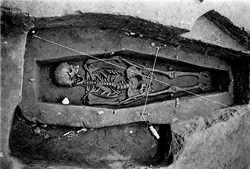
In 2003 his work appeared in an issue of the publication "Archaeology" after the photographer documented the remains of the hundreds of bodies which were uncovered from a parking lot two blocks north of New York's City Hall. This discovery made in 1993 challenged the popular belief that there had been no slavery in colonial New York. It also created controversy between the local black community and city developers who were planning to build over the "Old Negro Burying Ground". A team of anthropologists were brought in from Howard University to make certain that the ancestral remains would be handled with care and respect after a number of protesters laid down in front of bulldozers. "The African Burial Ground, as it is known today, became a "microcosm of the issues of racism and economic exploitation confronting New York City," says Michael L. Blakey, a Howard University anthropologist and the burial ground's scientific director. The research revealed many things about the lives of that these people led. Remains of many individuals exhibit bones that had been broken during life, severe physical strain and disease. One woman was found to have a musket ball lodged in her ribcage. many of these bodies were placed into the ground by their loved ones facing home, towards Africa. Twelve years after these bodies were exhumed, in 2003, they arrived back in N.Y. City and were taken in procession up Broadway to their final resting place, the African Burial Ground. Under the authority of the Antiquities Act of 1906, President George W. Bush proclaimed a 15,000 square foot portion of this site a National Monument on February 27, 2006. It is estimated that anywhere between 10,000 to 20,000 bodies are interned there. These estimates are considerably less than the number of bodies that currently lie beneath the interstate, North of the Lumpkin's Jail Site in Richmond's Shockoe Bottom. The NPS Archeology Program website refers to the monument in Manhattan as the oldest known urban African cemetery, but we can never be sure if this theory is true as Richmond's oldest cemetery remains inaccessible.

Thursday, October 18, 2007

VCU Lecture # 2: Kate Gilmore


Where is this magical school in Maine that both Kate Gilmore and William Pope.L have in common? I just want to go sit on the campus for a day and see what the hell everyone is doing there! Although I don’t think I will ever become a performance artist, this semester has influenced my way of thinking about the importance of performance art. I have a great deal of respect for anyone who can stand in front of the world and put themselves on display for the sake of their art. I love performing for my camera, when no one else is around, but as soon as other people are there I can’t concentrate and the meaning is lost. These artists however seem to thrive on the idea of an audience’s immediate response. Kate’s work has a strong entertainment element and the videos she showed were also formally and conceptually engaging. Her physical struggles in these performances often deal with the idea of the “perfect” character falling apart. Through this deterioration of character Kate is able to break conventional female roles. The characters in the beginning may seem inconsequential but as their struggle progresses so does our ability to empathize with them. Her performances also ask, what is it that motivates us to keep up the daily struggle in our lives? This concept was illustrated best in “anything”, where the artist constructs an impossible ladder out of chairs, string and a table in order to reach the camera overhead. Her willingness and determination to achieve her goal even in the face of danger is both comical and endearing. The one video that was hard for me to watch was when Kate was pushing her head through a star shaped hole in a piece of particle board. Although “Cake Walk” was probably more painful, overall I think there is something scary about a person hurting their face. While many of Kate Gilmore’s performances may seem lighthearted on the surface, one can still see a connection through certain elements to the more serious performance artists of the 1960’s and 70’s. Maria Abramovic’s work tends to be darker with little humor involved, however the two artists both base their performances on the element of danger and an action/ reaction situation where there is no way to be certain of the outcome. In my own work I often seek out places with an element of danger to perform. The risks of “being caught”, combined with the voyeuristic aspect of experiencing another person’s private life, are the dangers that work as a catalyst in the process of my art. The stranger or more unexplainable the circumstances of a place are, the greater is my desire to explore there.

Sunday, October 14, 2007

VCU Lecture # 1: Gail Dines


Gail Dines is a Professor of Sociology at Wheelock College in Boston. She received her Ph.D. from Salford University in England and is co-author of Pornography: The Production and Consumption of Inequality. Dines began her lecture at VCU last Thursday with a brief history on the relationship between pornography and capitalism in the United States. In 1953 the first edition of playboy magazine was published and became an instant success. What Hugh Hefner realized was that for the magazine to make money he would have to make advertising look sexy, thereby sexualizing commodity. Not only did he make it work, but fifty years later the mainstream media is still saturated with "sex sells" images. Dines then spoke about what it was like to grow up in a text based culture, vs. an image based culture. When porno magazines like Playboy first came out it would have been very difficult for young boys to acquire them, and most likely they would have to raid their parents stash in order to see them. Today, recent studies show that boys as young as 10 and 11 years old are likely to experience pornography for the first time on the Internet, and this type of porn is extremely graphic, body punishing and humiliating to women. The most common type of porn that is being marketed on the Internet today is not about sex, it's about violent and humiliating acts that strip women of their sexual autonomy. Not only are these images dangerous to (obviously) women everywhere, they are detrimental to young, impressionable boys who can access these sites. What kind of message do these images send to young men about women? That all women deep down are whores who like to be abused? Or maybe there's just a certain "type" of girl who it's okay to treat this way. The ideology of porn is so dangerous. It reinforces the "Madonna/Whore" stereotype so strongly that even women start to believe it, and then we are divided, we are judging each other and that's exactly what they want. If we're too busy arguing then we can't try to stop them from making money (not that we could really stop a 57 billion dollar industry if we tried). The massive inferiority complex that the pop culture/media industry has ingrained in us helps them to turn around and then sell us more makeup, more fashion magazines and more porn. Think about how much the mainstream media loves to hate Brittney, Paris and Lindsey when they sold them to us in the first place. What I will never understand is how intelligent women get caught up in trash culture talk. I've heard women pass judgement so harshly on each other and it breaks my heart. It is my belief that as a feminist it is counterproductive to call other girls whores, sluts or bitches. It is also important to remain compassionate towards sex workers because while they are working against what I believe in, they are still people with unfortunate circumstances, and if I condemn them then I'm no better than the men who are exploiting them. Yes, they make it harder for me to be seen as an equal and this infuriates me, but I also realize that they didn't create the market, and if there wasn't a market for it they wouldn't be selling it. Most women who end up in the porn industry are there because of drug addictions. Contracts from the companies almost always offer rehab as an incentive to have sex for money. Many girls also come from a childhood where they experienced sexual abuse and probably never felt any autonomy over their own body in the first place. The porn industry for most women is not really work; the relationship between these girls and their companies is closer to a master/ slave relationship than any other line of work in this country. Another point Dines made that I have always felt is true; radical feminists care about men a lot more than the companies who are making money off them. Feminists are opposed to the harmful ramifications of gender constructs for both women and men. For men to feel like they will be more desirable to women because of the car they drive or the amount of money they can throw around is a real pressure placed on them by a capitalistic society that wants to make them feel inferior, in order to then sell them what they are "lacking". It's interesting that feminists often are labeled man haters when in reality they are usually deeply compassionate people who have husbands and sons. If we are to believe that feminists truly hate men then what can be said of the men who are running the porn industry? Are they men lovers?

Wednesday, October 10, 2007

Artist Research: Clarissa Sligh


Clarissa Sligh teaches in the Graduate Photography Department at the School of Visual Arts in New York. Her artwork is based on family experiences and community stories. Through archival images and old photographs Sligh confronts issues of racism and sexism in a historically American context. In 1989 Sligh created one socially conscious piece as a site specific installation for a show at the Air Gallery in New York. This retrospective was titled “Mississippi in America: We Knew They Might be Killed”, and served as a commemorative for the murders of Michael Schwerner, James Chaney and Andrew Goodman. The exhibit marked the 25th anniversary of their deaths. The three boys were civil rights workers, all in their early twenties, who were working to register black voters in Meridian, Mississippi. When the Klu Klux Klan discovered this they made a premeditated plan to kill them all. All three boys were together one day in the June of 1964 when they were stopped and brought into the county courthouse on an alleged traffic violation. They were released later that day but on the way back to Meridian were stopped again on a remote road in the countryside. One by one the boys were executed and their bodies hidden. The investigation into this crime ended up being a catalyst for Civil Rights activists all over the country and drew national attention to the state of Mississippi. “It was an old-fashioned lynching, carried out with the help of county officials, a form of activity that had been going on since 1865, but the Federal Government had refused to intervene. Now "the nation" was shocked. Many historians say the government was finally mobilized to investigate the case primarily because two of the victims, Goodman and Schwerner were white.” Clarissa Sligh’s installation honors the memory of these three people who died fighting for the Civil Rights of others. There are many contemporary artists who are using the idea of the “memorial” in their work today. It serves as a vessel for expressing different emotions and political ideas. My work on the slave trade in Richmond helps me to communicate with people in my community about my frustration for the lack of awareness and disregard for African American history here. In the beginning stages of my research I encountered many people who didn’t know that Richmond played an enormous role in the slave trade. So much has been left unpreserved that it’s hard to tell where to place the blame when civil war hospitals have been turned into nightclubs and burial grounds lie underneath the interstate. An auction house still stands in the middle of downtown and there is no information about humans being sold from inside this place, not a single marker. I remember watching the movie Mississippi Burning with my parents when I was little. They didn’t shelter me from history at all so it was common for me to watch movies like this with my parents. I particularly remember watching one movie with my mother about the Lakota Indian massacre. When I cried my mother comforted me by saying “it’s okay to cry for all those people because if we don’t remember them then it’s like they lived for nothing”. I guess that memorials are just a way to reaffirm that belief, that people actually live for a reason.

Artist Research: Radcliffe Bailey


Radcliffe Bailey, a contemporary multi-media artist and Professor of Painting at the University of Georgia, uses personalized found objects as well as family photographs to create work that explores issues of race, heritage and memory. He draws inspiration from both African and African-American cultures and will often include images of ritual objects and the lyrics of slave spirituals in his art. Bailey's paintings and installations often refer to ideas of migration (both physical and spiritual), and they also reference family. In one series Bailey uses the vintage photographs of his ancestors and collages around the pictures dried flowers, sheet music and other artifacts. On working with personal family heirlooms Bailey says, "Growing up I spent a lot of time with my grandparents and great-grandparents and I feel like that's lost in most family's today. In my art, I try to restore some of the lost kinship between people". In a 2005 exhibit at the Jack Shainman Gallery in N.Y., Bailey showed a series of work that explores the experience of the Middle Passage Journey. The collages incorporate images of African symbols, model ships that have been painted black, drawings of ships and water, piano keys, flags and archival images of people in bondage. In the piece "Door of No Return, 2007" the artist has taken a photograph of the ocean and covers this with a sheet of black paper coated in glitter, which refrences the universe. He then cut out of this top layer a hole so the viewer can only see a square of ocean as if to say, "look, this is how an entire history is constructed." In one of Bailey's most recent works, which is a site-specific installation, an antique model ship lays on it's side and would appear to be wrecked among the debris of wooden planks. Although only one ship is visible the hundreds of wooden planks that lay scattered in a pile bring to mind the hundreds of ships that it actually took to make slavery possible and the countless number of lives that were claimed by this holocaust.

Artist Research: Michael Ray Charles


Michael Ray Charles is a Professor of Art in the Department of Art and Art History at the University of Texas, in Austin. His paintings investigate the legacy of racial stereotypes that have permeated the American subconscious since the days slavery. Drawing from the history of American advertising Charles uses iconic symbols from product packaging, billboards and commercials from both the present and the past to pose questions about the perceptions of black identity in America. Often the artist paintings reference figures from black memorabilia such as Jemima's, minstrel performer's and mammy's. "They're images that are constructed, they're both black and white, conceived in a white mind and believed in a black mind" says Charles. The very word memorabilia in my mind is problematic in the sense that it begs the question "who's memory?" In whose image were these cultural artifacts created? And what would our history be like if for two hundred years the tables were turned and blacks were in control of producing all the images we see of whites. Collectible items such as coin banks, salt and pepper shakers and syrup bottles adorned with images of black servants and performers were produced well into the early 1900's. After emancipation and during the Jim Crow era it was just one more way for white Americans to instill systematic racism. During these times there were parts of America where very few whites had ever seen a black person. Memorabilia and product packaging that functioned this way had an negative effect on how white America perceived African Americans at this time. In certain works like "(Forever Free) Now Playing" and "(Forever Free) #9", the figures are dressed up like jesters and clowns. They juggle and dance, grinning eternally as they perform the role that is expected from them by a white audience. Michael Ray Charles's paintings expose the elements of violence and humiliation that these kind of images encouraged. They are much subtler today, but as his work points out they still exist to promote black stereotypes in sports advertising and movies.